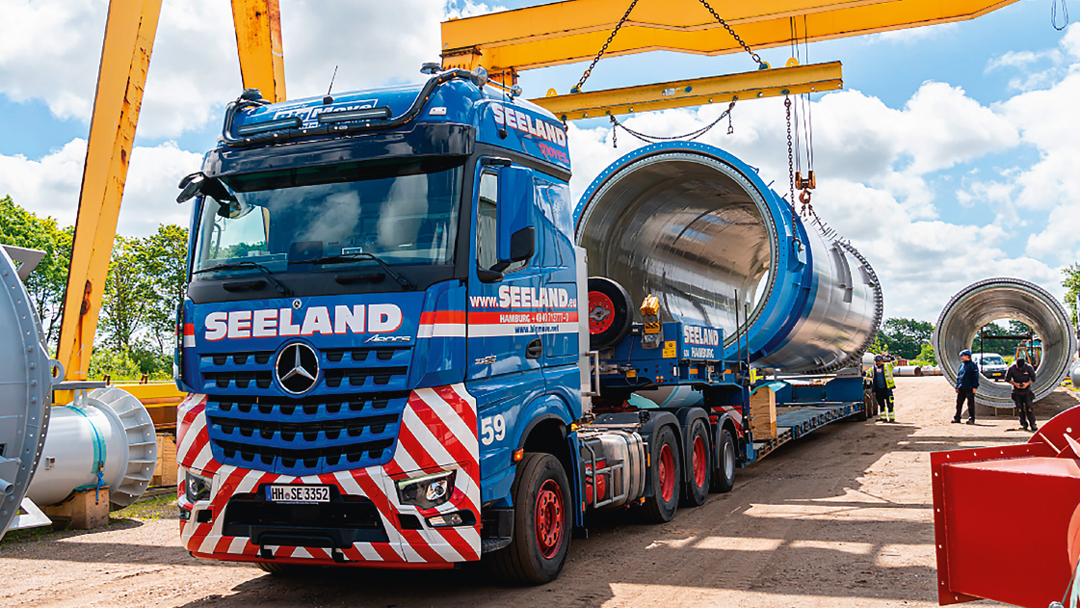
The HeavyBoost digital brokerage platform brings together cargo and free return transport capacity to minimise empty runs in heavy goods transport. The IT of the online platform, which received the BHV Project Logistics Award last year, was developed by Hanseatische Software-Entwicklungs- und Consulting GmbH (HEC), a company based in Bremen.
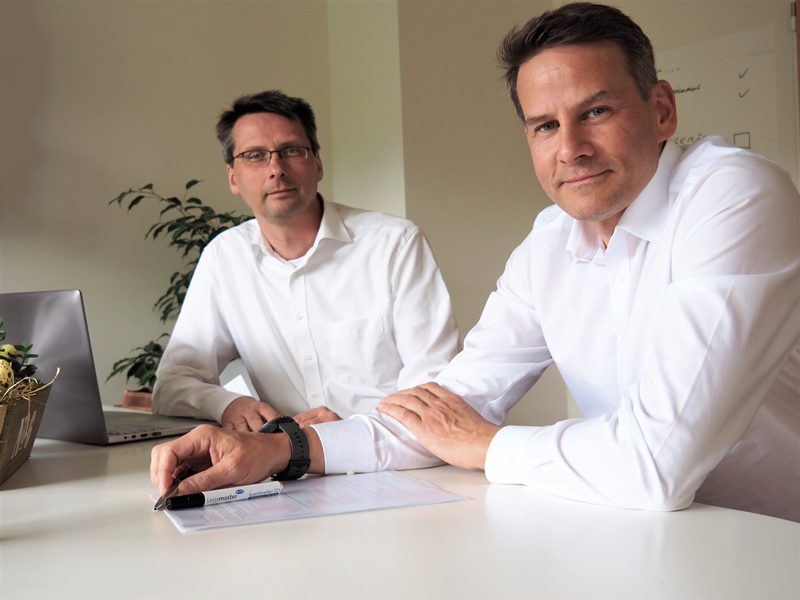
“In 2018, Heiko Müller and I met at SMM Hamburg, the world’s leading trade fair for the maritime industry,” says Beckedorf. During a walk in the Planten un Blomen park, which is not too far from the exhibition centre, it quickly became clear to both that they complement each other perfectly. “We can do it all, except for digital,” says Beckedorf. And that is precisely what the IT experts can do at Hanseatische Software-Entwicklungs- und Consulting GmbH (HEC), a Bremen-based company founded in 1988.
Digital platform tackles empty runs
A project company was therefore founded in 2019 to promote IT. The first element produced was the HeavyBoost digital platform for reducing empty runs, which was developed under the leadership of HEC logistics IT consultant Müller and his team in Bremen. “For highly efficient companies, the share of empty runs is around 18 to 20 per cent. According to estimates, it’s normally around 50 per cent.” The idea behind it is that a participant can register an underutilised run to find cargo for the return journey.
Standardised orders with permanent authorisation, which accounts for around 80 per cent of vehicles, and loads of up to 60 tonnes can be pooled. This includes full loads, larger or special cargo, and very small loads. Calculations are based on axle configurations, ensuring that the system can clearly determine which vehicle type is capable of transporting the cargo in question. With the aid of this form of standardisation, vehicles can be matched with exactly the right cargo.
“We deliberately kept the number of parameters small – with date, starting point, destination and vehicle class,” explains Müller. That also prevents companies from taking contracts away from each other on the platform. A dynamic matching algorithm analyses the data in real time and continuously calculates suitable journey combinations, thus reducing the number of unnecessary and empty runs. “You could say we’re the eHarmony for heavy goods transport,” say Beckedorf with a grin.
Suitable journeys in real time
If a logistics company registers an empty run from Berlin to Munich, for example, the algorithm searches for compatible cargo along this route, as well as suitable partial routes like Hanover to Ulm. “This reduces empty kilometres either partially or entirely,” adds Beckedorf. The result is greater efficiency in the transport fleet and lower operating costs. “The platform represents an investment in digital competitiveness,” highlights Müller.
Logistics companies do not require any additional IT. “We’ve developed an interface to freight forwarders’ transport management systems,” says Müller. The more orders there are in the system, the greater the likelihood of a match. The number of orders fluctuates significantly. “We have between 1,000 and 2,000 orders in the system each week, which has a significant impact on the matching rate,” explains Müller. “The average is ten per cent.” There is no system to monitor whether these runs actually take place. “Our portal merely suggests potential matches. We’ve designed it to be an open, low-barrier service, in order to leave the responsibility in the hands of the companies.”
Development of the platform required a six-figure investment and was also a very time-consuming process, as everything had to be designed and developed internally. “For the first three years, three of us got together for several hours every week,” recalls Beckedorf. Between 3 and 15 people were involved in the project. Communication with dispatch staff and management was essential to identifying actual demand.
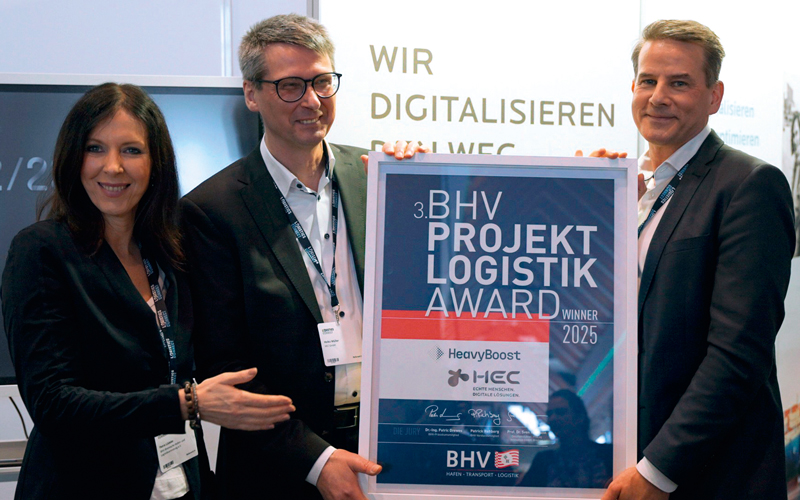
All this hard work was ultimately rewarded with the BHV Project Logistics Award in 2025. Beckedorf is already thinking ahead. “We’re assessing the idea of European and global expansion.” And in the future, artificial intelligence (AI) should help identify cargo hotspots.(cb)
Facts
Heavy Boost
Platform for automating journey optimisation and preventing empty runs in heavy goods logistics
Start: 2019
Headquarters: Wustermark (Brandenburg)