


“WATT MUTT, DATT MUTT!”
According to this Low German proverb, if you wish to make headway, you sometimes have to tackle tasks without more ado. This is also true for infrastructure and superstructure development in northern Germany’s ports. Even though it is often still unclear where the necessary funding will come from and how quickly implementation can take place, the local port industry is getting stuck in.
Credits: Adobe Stock/VDR, Fraport AG, bremenports, Seaports of Niedersachen, NPorts/Ulrich Wirrwa, APM Terminals, Stadt Papenburg
Looking back at the the 14th National Maritime Conference in Emden in late April 2026, German Chancellor Friedrich Merz called for a rapid expansion of maritime security. However, many industry representatives feel he left the question of just what financial resources and reforms the government would use to support the ports unanswered. Dr Pierre Dominique Prümm, Chair of the German Transport Forum Executive Committee (DVF) and member of the Executive Board at Fraport, shares this view. “Chancellor Merz mentioned 400 million euros from the Climate and Transformation Fund and 1.35 billion euros from the defence budget for infrastructure in Bremerhaven,” he explains. “However, this covers only a small fraction of what would be needed to develop seaports as energy hubs, making them resilient and fully fit for military purposes.” One of the DVF’s demands is therefore to increase what is known as the “port burden compensation scheme” – currently 38.3 million euros a year for all German seaports – to at least 500 million euros a year. “These funds are for ongoing maintenance,” Prümm adds. “Regardless, we need a further 15 billion euros to clear the maintenance backlog in the seaports.”
It is also clear to Prümm that the pending investments in port infrastructure can only be successful if they collaborate with the private port sector. “Terminals and equipment must be geared towards low emissions, digital security and dual-use applications,” he continues. “Structural reforms are imperative. This is of national responsibility, meaning the government shares this obligation.” Their task is to secure a new, sustainable basis for financing port infrastructure that applies to both inland ports and seaports.
“The Infrastructure Future Act that’s currently being planned is a positive step,” says Prümm with regard to the legal framework. “But there’s still room for improvement here too. To emphasise the importance of major infrastructure projects during the approval process, the German government is enshrining the overriding public interest of such projects in law. Ports must also fall into this category in future.” Moreover, it is essential that the import sales tax reform – otherwise known as the billing model – which he believes is long overdue, be tackled at national level. Prümm also sees a comparable need for action at EU level. Here, state aid rules for ports must be adapted to the new investment requirements, and revenue from emissions trading in maritime transport must be invested back into the climate protection sector. “The EU Ports Strategy addresses the security situation and the protection of ports in detail,” Prümm concludes. “Here, responsibilities and funding for security measures must be clarified urgently. In addition, I recommend that the EU Ports Strategy should focus more on removing regulatory barriers and on faster approval procedures, as well as revising the Water Framework Directive.”
Finally, the DFV chairman highlights the significance of sea access routes and hinterland connections for the competitiveness of ports. “The navigation channels on the Weser and Ems have needed dredging for decades,” he warns. “As regards the rail network, a renovation backlog of 130 billion euros has built up. Waterways are chronically underfunded. If we don’t speed up the tendering, planning and construction processes, it’ll take decades before an efficient, reliable and modern infrastructure is in place. The transport budget must therefore be increased and, through structural reforms, lead to faster and more reliable construction projects.”
Charting a course for the future
Apart from the fact that, alongside Prümm, numerous experts in the ports also criticise Germany’s protracted approval and planning procedures, Bremen and Lower Saxony have long since begun adapting their local ports’ infrastructures and superstructures to meet the new challenges. After all, those in charge are aware that new companies will only come to places where they find the best locations, and that long-established industries will only continue to invest if they are offered the necessary framework conditions for smooth import and export activities. Consequently, numerous projects have been launched (see diagram on page 6), some of which are briefly outlined below.
In October 2025, the launch of a tender process in Bremerhaven kicked off the renovation of container quays CT 1 to CT 3a. In several stages, the quay structure, spanning three kilometres, is to be redeveloped and equipped with modern cargo-processing equipment. The future development of ship sizes is to be taken into account, so that by the mid-to-late 2030s, even the most modern container ships with capacities of over 26,000 TEU can be handled there. “The reconstruction of the quay will secure Bremerhaven’s long-term competitiveness as a container port,” explains Christian Pabst, Head of Construction at bremenports. “Due to salt damage, the underwater concrete has deteriorated so severely in many places that something had to be done. We’re rectifying this now and, at the same time, bringing the 60-year-old facilities up to the latest standards.”

“Structural reforms are imperative.”
Dr Pierre Dominique Prümm, Chair of the German Transport Forum Executive Committee (DVF)
Construction of the new jetty in Bremerhaven is in full swing. The new structure will be 280 metres long and feature the historic lighthouse as its landmark.
The West Quay in Bremerhaven’s Kaiserhafen III is also being redeveloped – this is where Lloyd Werft’s Floating Dock III is to be moored in future. Consequently, almost 60 million euros is to be invested, creating space in the harbour basin for large converter platforms for offshore wind farms. By straightening the quay, which will then no longer jut so far out into the harbour basin, bremenports also intends to create more space for large ships to manoeuvre, thereby better addressing safety considerations. “Bremen is already doing a great deal to improve port-related infrastructure,” explains Pabst. “However, this is an ongoing process in which there’s still a lot to be done.”
Evidence of this is the Speckenbüttel port railway station expansion and modernisation, of which the ground-breaking ceremony recently took place in Bremerhaven. Around 56 million euros are being invested there in additional track capacity, modern signalling and safety technology, and digitalisation. Further, the so-called “20er-Gruppe” will see the creation of a new marshalling yard with seven additional tracks, each around 740 metres long. These are destined for handling container, automotive and military shipments. The new tracks are to be fully electrified and fitted with modern brake testing systems, points heating and state-of-the-art lighting. Meanwhile, the existing infrastructure is being comprehensively digitalised by integrating the signalling and safety systems into a digital signal box. “In Bremerhaven, rail accounts for over 50 per cent of hinterland transport, which is unique in Europe,” explains Henry Behrends, Head of Port Operations at bremenports, and adds: “In Speckenbüttel, we’re not only creating more space, we’re also sustainably strengthening rail freight transport to connect port and hinterland even more efficiently.”
The backbone of Germany’s energy transition
Excavators and heavy machinery are in use at many sites throughout Lower Saxony too. One key infrastructure project is the expansion of the Cuxhaven offshore port, destined to be Germany’s central energy hub. As part of this work, which has a price tag of roughly 300 million euros, three new heavy-lift berths (berths 5 to 7) will be expanded by late 2028, thereby closing the gap between the Europakai and the offshore terminals. “Since the early 2000s, Cuxhaven as a port location has developed extremely well, not least by recognising the specific needs of the wind energy sector at an early stage and developing suitable logistics services,” comments Inke Onnen-Lübben, Managing Director of Seaports of Niedersachsen. “Ongoing infrastructure and superstructure investment, plus the establishment of businesses such as Siemens Gamesa and other service providers, means Cuxhaven is now seen as Germany’s offshore industry hub.” With the further expansion of the local offshore port and around 38 hectares of additional transshipment and storage space by NPorts, she believes the location is making a significant contribution to the implementation of the energy transition in Germany. “This project has also resulted in the German government recognising that the energy transition can only succeed if it contributes to the investment and doesn’t let Lower Saxony and the private sector foot the bill alone,” she emphasises.
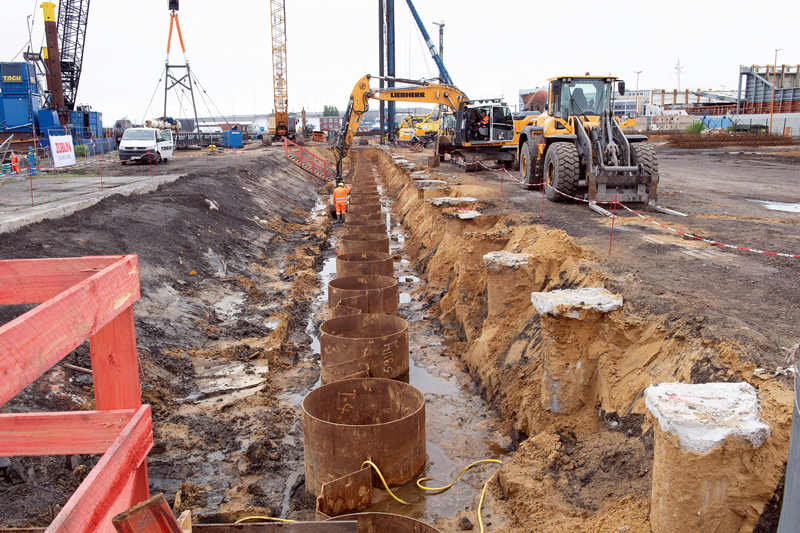
The redevelopment of the West Quay in Bremerhaven will create more space, both for building converter platforms for offshore wind energy and for manoeuvring large ships.
In August 2025, the expansion of a berth for large vessels by NPorts in Emden, around 160 km to the west, began. The project, for which an investment of around 70 million euros has been earmarked as part of the Ems 2050 Master Plan, will close the existing gap between Emskai and Emspier and will, in future, enable the handling of vessels up to 265 metres in length, 36.5 metres in width and with a draught of 10.7 metres. A new approx. 23‑hectare terminal area is also being built there. “This will allow processes to be optimised effectively, particularly when handling vehicles, pulp, general cargo and military goods,” explains Onnen-Lübben, referring to the Ems fairway adjustment project, which has been at the planning stage for 25 years. From the perspective of Emden’s port industry, this is essential to compensate for the impact of tidal control on the site’s accessibility from the sea.
Finally, over the past two-and-a-half years, the “Value Port Papenburg” project has seen the expansion of the North Port into a modern industrial and logistics hub – by the city of Papenburg – with funding from the state of Lower Saxony and the district of Emsland. These measures contributed to the expansion of the port by around 9,500 m² and dredging to a water depth of six metres. Further, a new, approximately 800-metre-long sheet pile wall was also erected. “This project was initiated due to the high demand for commercial and industrial space, as well as the need for local businesses to expand,” Onnen-Lübben explains, adding that the successful implementation of the project on site has now created significant infrastructural conditions for growth, innovation and new settlements, while simultaneously driving the development of the location forward in terms of the circular economy and recycling. The project is not yet complete, however. “More industrial and port areas are also planned in the Bokeler Bogen area,” Onnen-Lübben continues, “creating several hectares of industrial land for new businesses and making Papenburg more attractive as a business location.”

“Bremen is already doing a great deal to improve port-related infrastructure.”
Christian Pabst, Head of Construction at bremenports
“Rail accounts for over 50 per cent of hinterland transport in Bremerhaven.”
Henry Behrends, Head of Port Operations at bremenports

“The project was initiated due to the high demand for commercial and industrial space.”
Inke Onnen-Lübben, Managing Director of Seaports of Niedersachsen
Three new heavy-lift berths will be built in Cuxhaven by 2028 as part of the offshore port’s expansion.
“Resilience can’t be built in a silo”
Looking beyond specific locations and projects, Olaf Gelhausen, COO at the port and terminal operator APM Terminals – part of the Danish shipping and logistics group Maersk – reflects on the importance and resilience of port infrastructure. In his view, these are crucial for the global security of supply, which is why the “terminals of the future” must not be considered per se. “A port is only as strong as the system it’s embedded in,” he states. “Terminal design, hinterland connections, energy supply and nautical infrastructure must be thought of together.” For him, one thing is clear. “Resilience can’t be built in a silo, but through collaboration. This also means that we must work closely with local governments and port authorities to ensure that investments in rail, road access, energy supply, shore power, network expansion or necessary fairway adjustments are made in good time.”
In this context, Gelhausen does not see the existing structures within the ports – nor those beyond the quaysides – as an accidental by‑product. “The trade routes the global economy is based on today didn’t spring up overnight,” he explains. “They were built up, consolidated and optimised over decades.” He also spoke about current geopolitical developments. “Similarly,” he continues, “reorganising them won’t be a short-term disruption, rather a profound transformation spanning many years.” He feels, however, that many companies are already adapting to the new reality. “They’re reviewing where they manufacture, where they source their supplies and how their supply chains can be more resilient,” he adds, emphasising the importance of partners who can act decisively in the short term, while simultaneously making long term investments in modern, efficient and critical infrastructure.
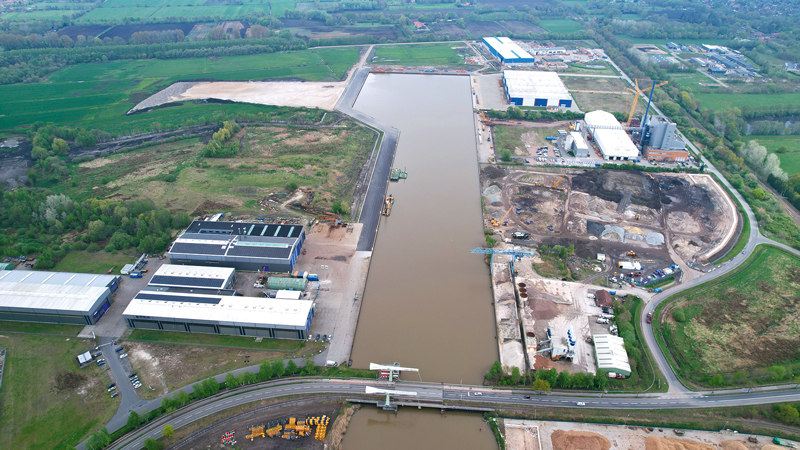
By expanding North Port into a modern industrial and logistics hub, Papenburg is creating key infrastructural conditions for growth and innovation.
He sees the Gemini Cooperation – a strategic alliance by Maersk and Hapag-Lloyd on services running between Asia and Northern Europe since early 2025 – as exemplary of such dual expertise. “The network demonstrates that reliability in our industry can be taken to a new level,” he says. “The aim is clear – industry-leading adherence to schedules. However, this requires ships, routes and, above all, strong ports in the right locations. Indeed, efficient terminals are the backbone of a resilient logistics network.” He refers to the Bremerhaven site, in particular, which he believes plays a pivotal role, and not only within the Gemini Cooperation. “This year, we signed a contract with EUROGATE for the modernisation and development of the NTB terminal,” he explains. “This also includes an investment of one billion euros to create a more efficient and increasingly electrified terminal as we strive for zero-emission operations.” If the NTB can achieve net‑zero in the future, it would be the first terminal of its kind in Germany. However, the contractually agreed investments are still subject to internal and external approvals. Both APM Terminals and EUROGATE currently expect the transaction to be completed in the third quarter of 2026. (bre)
“A port is only as strong as the system it’s embedded in.”
Olaf Gelhausen, COO, APM Terminals