


Adaptability – the key to success
The transformation of ports into central hubs for a climate-neutral economy is in full swing – with far-reaching implications for core funding, the hydrogen and wind energy markets, as well as the supply of shore power to ships. Major players envisage not only “tough transformation challenges” but also favourable conditions and opportunities. However, this can only be achieved if ports demonstrate their adaptability and receive appropriate support from the German government.
Credits: Gemini, ZDS/Hendrik Lüders Fotografie, Meinen & Eden Fotografie, Wirtschaftsförderung Wilhelmshaven mbH, EWE, Bundesverband Windenergie Offshore, bremenports, Nordex
For Dr Reiner Brüning, Energy Policy Adviser at the Association of German Seaport Operators (ZDS), the situation currently facing ports is the result of a trend that has been emerging slowly over time. “In recent years, ports have evolved from being purely transshipment points for goods into key energy hubs,” he explains. “Meanwhile, global interdependencies regarding the energy supply have grown steadily. Consequently, over 60 per cent of our energy requirements must currently be imported via German ports.”
With this in mind, Brüning has identified several energy-related challenges in Germany that he believes require action. Greater support for ports from the German government heads his list. “Basic funding – at EUR 38.3 million annually – hasn’t been adjusted for decades,” he continues. “This requires urgent reform. To prevent the investment backlog of around EUR 15 billion identified by the ZDS from arising again, we believe that basic funding should be increased to EUR 500 million per annum. This is the only way ports can function in the long term regarding tasks of national importance, like the energy transition, digitalisation, technological developments and automation. Plus, as per the ZDS’s assessment, at least EUR 6 billion is needed for energy transition that is relevant to port infrastructure, so ports can advance Germany’s decarbonisation process further.” This is not a cash injection for just any random sector. “It’s actually support for a pillar of the German economy that has recently become increasingly crucial for the nationally important tasks I mentioned before,” he clarifies.
As part of the energy transition, ports are also called upon to become a fundamental component of what is known as Carbon Capture, Utilisation and Storage (CCUS) and CO₂ transport infrastructure. “Ports must be acknowledged as being part of CO₂ management, so the roll-out can begin immediately, instead of having to wait for a nationwide pipeline network to be built,” Brüning adds. “This means it’s essential that port infrastructure required for CO₂ handling, temporary storage and onward transport is seen to be in the overriding public interest. We also need to establish multimodal transport chains that comprise ships, rail and lorries as quickly as we can.”
Regarding alternative fuels, he also criticises the fact that a lack of incentives for first movers has left ports, shipping companies and fuel suppliers in a state of paralysis. “We need effective derisking mechanisms and clear incentives, such as investment grants and capacity utilisation guarantees, here to drive the development of infrastructure for alternative fuels forward,” he outlines. Finally, Brüning and the ZDS advocate increasing the provision of heavy-load-bearing areas for wind energy technology in the ports. “This is the only way we can achieve the offshore expansion targets of at least 30 gigawatts by 2030,” he adds. “Furthermore, current planning must take into account the fact that we’ll need additional space for the repowering, decommissioning, dismantling and recycling of wind turbines in the 2030s.”
“A challenging phase with tough transformation tasks”
One landmark project as part of the energy transition is the Port of Wilhelmshaven ENERGY HUB, where the deep-water port is to be converted into Germany’s central hub for renewable energy and green hydrogen. To accomplish this, 50 member companies and partners from the regional business community are investing around EUR 18 billion to create an integrated system on site that combines energy import, generation, storage and distribution, thereby meeting a large proportion of Germany’s future energy needs. “Wilhelmshaven has been a linchpin of Germany’s energy supply for many years,” states Yannis Fischer, Project Manager, Wilhelmshaven ENERGY HUB. “So far, we’ve relied on fossil fuels such as oil, coal and gas but electricity from wind energy, hydrogen and hydrogen derivatives is becoming an increasingly significant source of energy.”
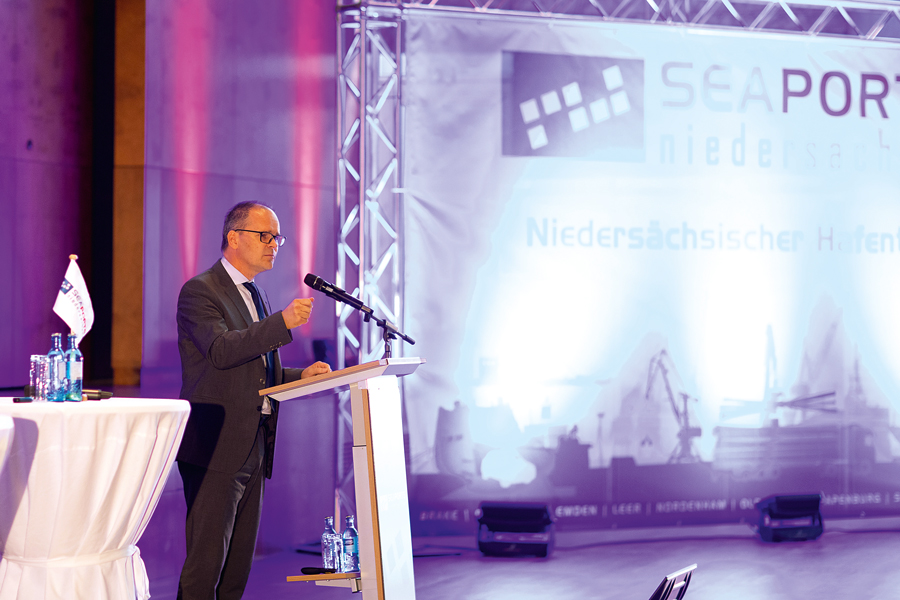
The ZDS is not alone in calling for better financial support for ports from the German government; this is a hot topic elsewhere too. Lower Saxony’s Minister of Economic Affairs, Grant Hendrik Tonne, also addressed it at the 34th Lower Saxony Port Day in Papenburg in September 2026.
For Fischer, the hub’s concept revolves primarily around two main pillars – hydrogen production and distribution, and exporting unavoidable carbon dioxide (CO₂) from industry. “As Germany’s only deep-water port, Wilhelmshaven has a water depth of more than 18 metres, meaning that large carriers can call at the port 24/7, carrying methanol or ammonia for example,” he continues, summarising what he feels are the most compelling arguments in favour of the location. “Plus, with the existing tank farms and salt caverns and the numerous pipelines, there’s already an extensive storage and distribution system in place that’s connected to Germany’s core hydrogen network.” Furthermore, specialised terminals, designed to collect and temporarily store CO₂, before either storing it deep beneath the seabed of the North Sea via ship or pipeline, or using it in the green gas cycle, are being planned.
Implementing the ENERGY HUB successfully requires the completion of a three-step process. Firstly, the necessary energy infrastructure, comprising the power grid, more pipelines and additional facilities, will be established by 2030. The first expansion phase will then follow in the early 2030s and the second phase by 2035. “This is a dynamic structure that’s under constant development,” Fischer states. However, he also makes it clear that he believes the energy sector in Germany is currently going through a challenging phase with tough transformation tasks. “These aren’t local problems,” he explains. “They actually lie in Brussels and Berlin. The right framework conditions to allow relevant markets to emerge and enthuse customers for hydrogen haven’t been established there yet.” There is still a substantial need for improvement in this area.

“Over 60 per cent of our energy requirements is imported via our ports.”
Dr Reiner Brüning, Energy Policy Adviser at ZDS

“Wilhelmshaven has been a linchpin of Germany’s energy supply for many years.”
Yannis Fischer, Project Manager, Wilhelmshaven ENERGY HUB
A visualisation of the electrolyser currently under construction in Emden as part of the “H2Coastlink-1” project.
Favourable conditions for energy transition success
For Alexander Malchus, in charge of Hydrogen Business Development at EWE, the North-West region offers the best conditions for the energy transition to succeed. “Alongside the ideal geographical conditions for onshore and offshore wind power, the existing grid infrastructure and storage options, it’s primarily the adaptability of our ports that bodes well for a successful transformation,” he states. Hydrogen is particularly close to his heart, as he believes the energy transition can only be achieved using this energy source. Accordingly, EWE is focusing on developing an ecosystem early on that encompasses all four stages of the hydrogen value chain – production, storage, transport and usage. For Malchus, this also includes port terminals capable of offloading hydrogen and its derivatives from ships. Which technology and which transport sector will prevail in this regard is still up in the air. “Many derivatives, such as ammonia, store more energy per unit volume than pure hydrogen does and, thus, are more favourable when it comes to transport,” he clarifies. “But this then requires additional infrastructure, such as an ammonia cracker, at the destination port to extract the hydrogen again.”
He believes north-western Germany is ideally positioned for large-scale hydrogen storage, particularly due to the region’s numerous salt caverns. As regards transport, he places primary focus on the existing natural gas pipelines, spanning over 9,000 kilometres, which also form the basis for Germany’s core hydrogen network. This all creates the ideal conditions for keeping potential buyers of hydrogen and its derivatives – such as the steel and chemical industries – supplied in the future. “It’s clear that, in the long term, our ports offer great potential for importing large quantities of green gases,” he emphasises.
Machus views the “H2Coastlink-1” and “H2Coastlink-2” projects as key milestones – these form part of the “Clean Hydrogen Coastline” (CHC) infrastructure programme and are currently being put into practice. The former is an approximately 24-kilometre hydrogen pipeline designed to connect an electrolyser in Emden to the national hydrogen core network at the Leer site. The second project involves a section of transmission pipeline running from the underground cavern storage facility in Huntorf to Sandkrug. Here, 28 kilometres of existing pipeline will be extended by six kilometres of new pipelines. He also mentions the “H2Coastlink-3” to “H2Coastlink-5” follow-up projects, planned for the north-west, which have been shortlisted, but not yet given green light for investment.
“Inconsistent political decisions, complex regulation and geopolitical shocks have cost us a great deal of time in the past,” he concludes. “I am, however, certain that the first major projects will begin by the end of 2027, sending a clear signal to the market that hydrogen is coming!”
<h3“Hydrogen is coming!”
Alexander Malchus, Hydrogen Business Development at EWE
Hungry for a bigger slice of the “offshore pie”
Hans Sohn, Head of the Policy and Communications Unit at the German Offshore Wind Energy Association (BWO), predicts that German ports have a good chance of succeeding in the energy transition via offshore wind energy. For example, they should create longer quaysides and more heavy-load-bearing areas to be able to handle the installation and maintenance of monopiles, nacelles and rotor blades weighing many tonnes. Furthermore, he indicates that, from the 2030s onwards, enough space also needs to be set aside in the ports for the decommissioning and recycling of first-generation offshore wind turbines, so as to enable participation in this sector.
“Germany’s ports are a crucial part of the expansion of offshore wind energy, which is why we have to keep bottlenecks from occurring,” states Sohn. In this context, he admires the developments in the Netherlands and Denmark. “Eemshaven and Esbjerg got a lot right early on and have expanded their ports for the energy transition,” he continues. “Esbjerg, for example, has enabled the offshore wind energy sector and the military to share use of the ports.” As this new era unfolds, Sohn can also, in principle, envisage such situations in Germany. However, existing concerns within the industry – i.e. that the wind energy sector would have to take a back seat to the military in the event of a crisis – must firstly be addressed.
Sohn considers Cuxhaven to be a prime example of infrastructure development conducive to wind energy. Three new heavy-lift berths and a 38-hectare terminal area are currently under construction there to provide logistical support for coming generations of offshore North Sea wind farms. “With the German Offshore Industry Centre and this large-scale project, Cuxhaven has become a flagship for the sector,” he adds. Indeed, this sector, which installed 1,764 offshore wind turbines with a capacity of 10.8 gigawatts in Germany as of June 2026, is set to increase its capacity to 30 gigawatts by 2030, as per the Offshore Wind Energy Act. “I’m certain we won’t achieve this target,” Sohn states, “mainly due to a delay in offshore grid expansion. A target of 40 gigawatts by 2035 is more realistic.” Long-term expansion, however, requires close coordination at European level regarding the speed of the expansion and the readiness of German ports to implement the infrastructural requirements of the offshore energy transition mentioned previously. “We’ve handed out plenty of freebies to our neighbours in this regard,” he continues. “Now, we should seize the chance to secure a bigger slice of the offshore pie for ourselves.”
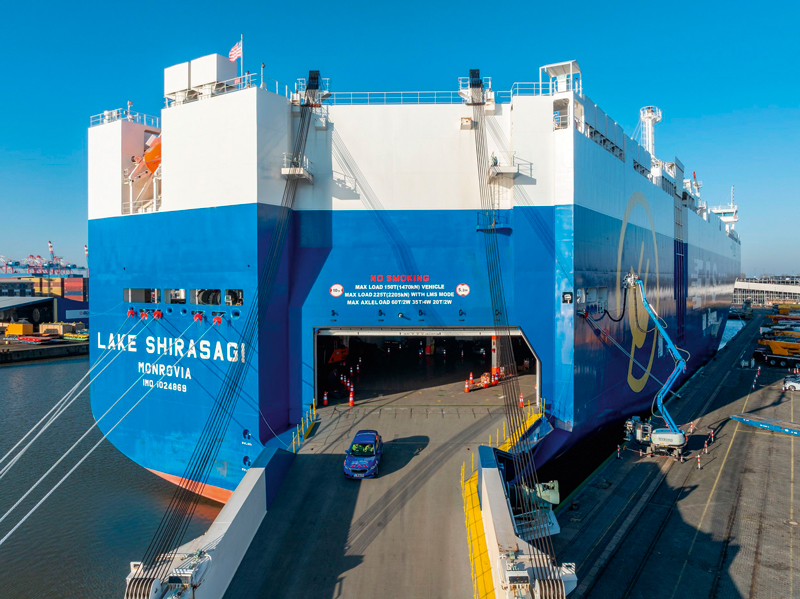
Bremerhaven: The “Lake Shirasagi” became the first car carrier in Europe to receive shore power while docked.
Bremen opts for shore power
In January, Bremerhaven sent a strong message in support of the decarbonisation of shipping and sustainable infrastructure. At the Nordhafen RoRo terminal, the “Lake Shirasagi” became the first
car carrier in Europe to receive shore power while docked. This allowed the ship to switch off her on-board diesel generators and draw green electricity from renewable energy sources onshore, thereby reducing her emissions of CO₂, nitrogen oxides and dust particles.
This step has allowed the shore power infrastructure in Bremen’s ports to gain real momentum. Lutz Jankowsky, Head of Technical Facilities at bremenports, expects that around the time this issue of LOGISTICS PILOT goes to press, the first shore power supply for large container ships in Bremerhaven will also be set to go live. “The system has been in the test phase since July,” he explains. “There are still a few minor issues here and there where the onshore and on-board systems don’t match up perfectly, but I’m confident we’ll get this sorted out quickly and will be able to commission two more systems for container ships at the site as early as January.” Similarly, at Berth A on the Columbuskaje in Bremerhaven, the power supply chain has already been installed in a 300-metre channel for cruise ships. This is where the mobile power outlet, which supplies the shore power cables for transfer to cruise ships, is connected. “I’m certain this project will also get under way at the end of this year,” he adds.
Plus, the shore power package for Bremen’s ports comprises a total of 26 berths for inland waterway vessels – three in Bremerhaven and 23 in Bremen. “These have been in operation for quite some time now,” says Jankowsky. “In terms of complexity, they’re nowhere near as sophisticated as the facilities for large ships. Essentially, inland waterway operators can simply put a plug in a socket, just like at home, and draw up to 43 kilowatts of power.” In contrast, the potential power draw is said to be up to 16 megawatts with shore power facilities for cruise ships. “That’s enough to power a medium-sized village,” he adds. However, he is quite sceptical concerning the EU regulations Alternative Fuels Infrastructure Regulation (AFIR) and FuelEU Maritime, which mandate that European ports provide shore power infrastructure by 2030. “It’s unlikely to be feasible, either technically or financially, to bring all port facilities into line with the legal requirements within this timeframe,” he continues. “In principle, though, these requirements would also be met if ships could run on green hydrogen, methanol or battery-electric propulsion by then,” he adds with a wink. (bre)

“We have to keep bottlenecks from occurring in our ports.”
Hans Sohn, Head of the Policy and Communications Unit at the BWO
“The shore power infrastructure in Bremen’s ports has gained real momentum.”
Lutz Jankowsky, Head of Technical Facilities at bremenports