Global trade routes often face pressure. And yet trade continues – even if along different paths. Current figures and voices in the industry reveal what that means for the Bremen and Lower Saxony seaports.
The lion’s share of commodity flows through the major trade corridors of the Far East and the North Atlantic. According to figures of the German Federal Statistical Office (Destatis), freight handling increased by 3.8 per cent to 284.4 million tonnes in 2025, driven primarily by the receipt of goods from abroad, which increased from 5.3 per cent to 171.1 million tonnes. In contrast, freight transport grew by just 0.5 per cent. In other words, Germany’s ocean imports expanded much more than its exports. The shift in energy imports was particularly strong, with the receipt of US natural gas increasing by 51.8 per cent and the import of crude oil from the US dropping by 23.6 per cent.
Among recipient countries, Norway again led the way at the Bremen ports in 2025 with 4.36 million tonnes, followed by China with 3.49 million tonnes. The People’s Republic thus grew significantly compared to 2023 (2.61 million tonnes) and 2024 (3.05 million tonnes), underlining its growing significance as an export country. Poland secured third place with 2.99 million tonnes, whilst the US remained stable with 1.71 million tonnes, achieving seventh place as in the year prior, compared with sixth place in 2024.
At 4.90 million TEU, container transshipment at the Bremen ports made significant recovery in 2025, compared to 4.18 million TEU in 2023 and 4.45 million TEU in 2024. Most remarkable is the increase in traffic to the Far East, from 630,000 the year prior to 732,000 TEU, and to the Middle East, up from 313,000 to 327,000 TEU in the same period. At 344,000 TEU, Africa maintained a high level, whilst the North Atlantic stabilised at 730,000 TEU.
More car imports, fewer car exports
The structural change continued in vehicle transshipment, for which Bremerhaven is Europe’s second largest port. A total of 805,162 vehicles were dispatched in 2025, compared with 864,843 in 2024. Import of Asian vehicles, in particular, trended in the opposite direction, increasing from 387,915 the previous year to 446,561.
There were also significant changes in commodity flows at Lower Saxony’s seaports, which at 60.5 million tonnes handled nine per cent more in 2025 than in 2024. Most remarkable is the change in energy sources. Whilst LNG increased by 36 per cent and fuels by 18 per cent in Wilhelmshaven, the handling of crude oil dropped by 17 per cent.
At 1.47 million TEU, JadeWeserPort handled 74 per cent more containers than in the previous year, reinforcing its role in container transport. This development is primarily down to the Gemini Cooperation between Maersk and Hapag-Lloyd, which has transformed Wilhelmshaven into its German hub.
Andreas Bullwinkel, President of Wilhelmshavener Hafenwirtschafts-Vereinigung, has observed concrete shifts in fast-moving consumer goods. “The FMCG segment from Asia to Wilhelmshaven has increased significantly due to tariff issues,” he says, adding that the same applies to the automotive segment. “Here, too, the volume of passenger cars shipping from Chinese production to Wilhelmshaven has expanded dramatically.” European car manufacturers also used Wilhelmshaven more frequently as a destination port. Like potential military applications, he also views the planned multi-purpose terminal for RoRo and wind turbine handling as well as the planned permanent facility for liquefied gases as opportunities.
Ukraine war shifts agricultural flows
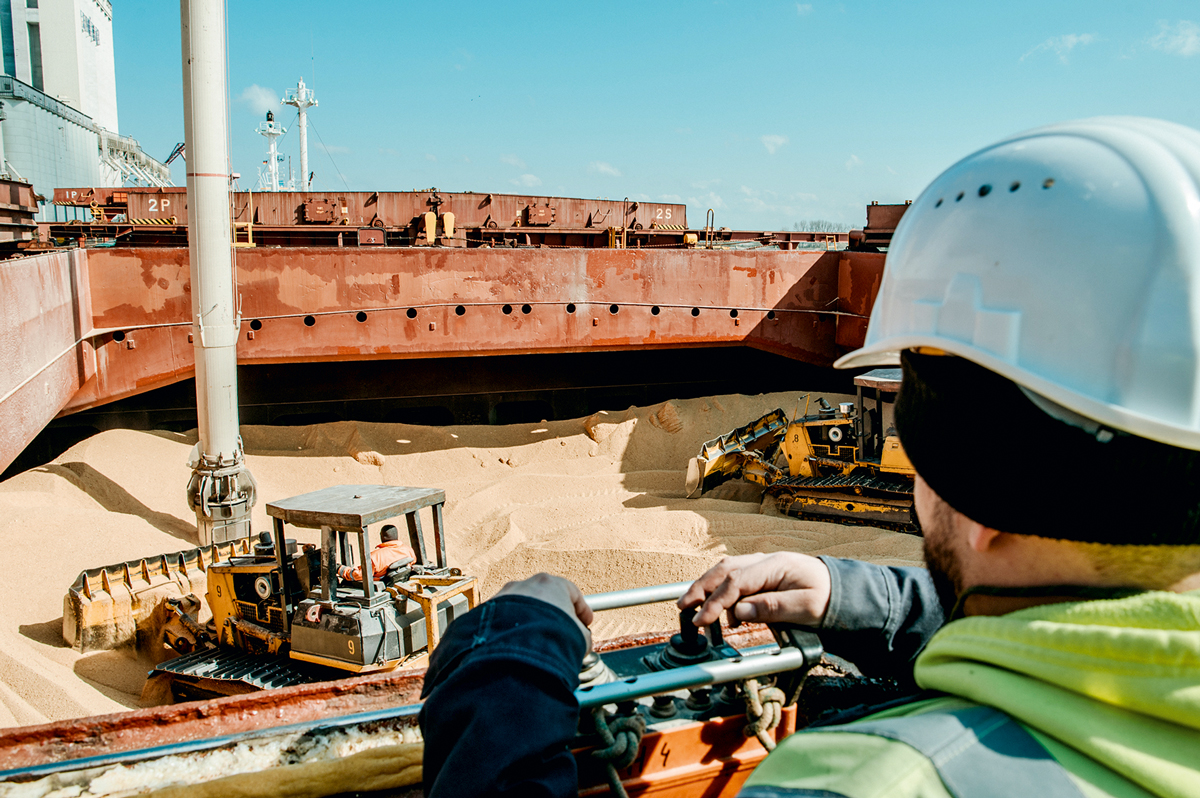
Geopolitical disruptions are also apparent in the flow of goods in Brake, a central bulk and general cargo port on the German North Sea coast. “The Ukraine War has significantly shifted commodity flows in agricultural and bulk cargo, in particular,” reports Uwe Schiemann, Managing Director of J. MÜLLER Weser, adding that traditional ocean shipments of grains and agricultural products from Ukraine have largely ground to a halt, as alternative flows from other Eastern European countries are unable to offset the loss in volume. But Schiemann expects volumes to bounce back after the war, restoring Ukraine’s significance as a breadbasket.
Marc-Simon Vick, Managing Director of Area Germany & Central Europe at Hapag-Lloyd, sees the impacts of geopolitical disruption particularly in individual goods segments. Energy-intensive industries like the chemicals segment are under pressure due to high energy costs, and European export industries have seen a drop in demand from Asia. Both factors are reflected in declining volumes. Industrial supply chains, on the other hand, have remained stable.
“Their development is shaped not only by global trends, but also by deliberate management within the networks,” says Vick, explaining what that means for German ports – particularly Bremerhaven and Wilhelmshaven. “By adding new connections and actively directing traffic flows, individual ports can expand their activities and tap into new growth potential.” (cb)