



“It’s now five past twelve!”
Colonel Thomas Geßner, Commander of the Bundeswehr’s Regional Territorial Command Bremen, and Uwe Oppitz, Group Managing Director of Rhenus Ports, consider the current situation in the “Key Region North-West” through the lens of the Operational Plan for Germany (OPLAN DEU), a classified strategic Bundeswehr document that governs Germany’s defence in the event of an alliance contingency and crisis situation. In other words, analysis of the status quo from a military and civilian point of view.
Credits: Landeskommando Bremen der Bundeswehr, Rhenus Logistics
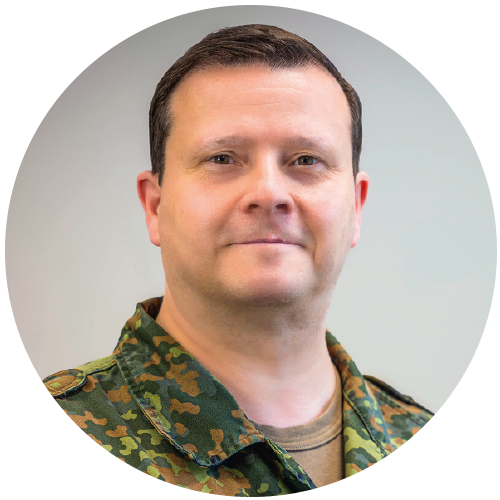
“We’re threatened and essentially attacked on a daily basis.”
Colonel Thomas Geßner, Commander of the Bundeswehr’s Regional Territorial Command Bremen
LOGISTICS PILOT: How dangerous do you consider the current situation to be?
Colonel Geßner: The current situation is serious! We’re threatened and essentially attacked on a daily basis! Russia has brought an armed conflict to Europe with its unlawful war of aggression against Ukraine. You can no longer talk about peace in Central Europe. Whilst we may not yet find ourselves in open conflict, Germany is already facing hybrid attacks from adversarial actors – disinformation campaigns, cyberattacks, espionage and sabotage – the perpetrators of which are usually difficult to define.
Oppitz: I’m alarmed by the current situation in the world. Over and over again, we’re confronted with the fact that we live in a world in which nations like Russia, North Korea and the US have broken with established norms and are making a mockery of important values. This is something I encounter not only daily in the media, but also with colleagues based in Iran, Oman and Dubai, who can no longer communicate freely – in part because channels like WhatsApp and the Internet are blocked. I have the feeling that German society and politics are not yet in a position to effectively adapt their mindset to the current situation. And that’s despite the fact that it’s already “five past twelve”.
Colonel Geßner: The current situation is serious! We’re threatened and essentially attacked on a daily basis! Russia has brought an armed conflict to Europe with its unlawful war of aggression against Ukraine. You can no longer talk about peace in Central Europe. Whilst we may not yet find ourselves in open conflict, Germany is already facing hybrid attacks from adversarial actors – disinformation campaigns, cyberattacks, espionage and sabotage – the perpetrators of which are usually difficult to define.
Oppitz: I’m alarmed by the current situation in the world. Over and over again, we’re confronted with the fact that we live in a world in which nations like Russia, North Korea and the US have broken with established norms and are making a mockery of important values. This is something I encounter not only daily in the media, but also with colleagues based in Iran, Oman and Dubai, who can no longer communicate freely – in part because channels like WhatsApp and the Internet are blocked. I have the feeling that German society and politics are not yet in a position to effectively adapt their mindset to the current situation. And that’s despite the fact that it’s already “five past twelve”.
LOGISTICS PILOT: What does the Operational Plan for Germany mean for German seaports against this backdrop?
Colonel Geßner: The OPLAN DEU is the core element of the military side of Germany’s comprehensive defence. This plan brings together the central military elements of territorial and alliance defence in Germany and the required civilian support services, with the aim of ensuring targeted action in the event of a crisis and conflict scenario. Given its central location in Europe, Germany plays a critical role as a logistics hub for troop deployment in ensuring credible deterrence and effective defence. We need to guarantee the “continuity of advance” as well as protect and supply our allies abroad. German seaports in the North Sea are essential, particularly when it comes to transporting materials to NATO’s eastern flank, as they ensure our access to the Atlantic Ocean.
Oppitz: The ports in Lower Saxony are already well positioned. Nevertheless, I’m certain that requirements will increase dramatically. Especially if the alliance contingency or state of defence were to be triggered, in which case the ports would increasingly serve as logistical hubs for the handling of troops and heavy military equipment. But for that to happen, additional spaces, facilities and measures for drone defence and sabotage prevention would need to be established – and then there are the challenges that would arise in heavy load approval for RoRo ramps and cranes. But because the ports have recently been classified as critical infrastructure, the government is investing heavily in their infrastructure and expansion as military logistics hubs, with 1.35 billion euros going to Bremerhaven alone.

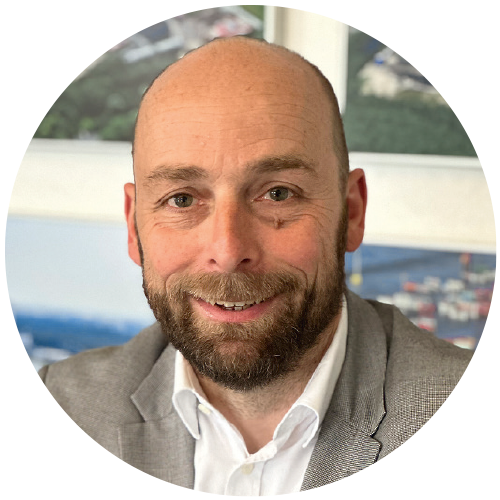
“Additional spaces, facilities and measures for drone defence need to be established.”
Uwe Oppitz, Group Managing Director Rhenus Ports
LOGISTICS PILOT: How will the Bundeswehr and industry have to collaborate to ensure the OPLAN DEU will work?
Colonel Geßner: The OPLAN DEU manages quick deployment and the supply of allied and domestic forces in crisis and war. In accordance with NATO planning, several hundred thousand soldiers will need to receive logistical and medical support and protection under enormous time pressure. The resilience of both our military and society as a whole is an essential component of NATO deterrence planning and requires close collaboration between industry and the Bundeswehr. The seaports in the North Sea, in particular, will face enormous logistical challenges that can only be overcome with intact, well-functioning port infrastructure and other types of infrastructure.
Oppitz: The security policy dialogue between the Bundeswehr and the port companies is already progressing at a good pace. In fact, recent years have seen intensive exchange across multiple levels for that purpose alone. For example, Regional Territorial Command Lower Saxony regularly visits ports in Lower Saxony to discuss equipment with the operators and get a picture of current developments on site. Exchanges of viewpoints between the Bundeswehr, businesses and science were also high on the agenda at the LOG.NET trade fair in Koblenz this past March – with a primary focus on military logistics solutions, digitalisation and resilience. These and other channels also provide Berlin with a clear picture of port capacity and potential road, waterway and rail connections.
Colonel Geßner: The OPLAN DEU manages quick deployment and the supply of allied and domestic forces in crisis and war. In accordance with NATO planning, several hundred thousand soldiers will need to receive logistical and medical support and protection under enormous time pressure. The resilience of both our military and society as a whole is an essential component of NATO deterrence planning and requires close collaboration between industry and the Bundeswehr. The seaports in the North Sea, in particular, will face enormous logistical challenges that can only be overcome with intact, well-functioning port infrastructure and other types of infrastructure.
Oppitz: The security policy dialogue between the Bundeswehr and the port companies is already progressing at a good pace. In fact, recent years have seen intensive exchange across multiple levels for that purpose alone. For example, Regional Territorial Command Lower Saxony regularly visits ports in Lower Saxony to discuss equipment with the operators and get a picture of current developments on site. Exchanges of viewpoints between the Bundeswehr, businesses and science were also high on the agenda at the LOG.NET trade fair in Koblenz this past March – with a primary focus on military logistics solutions, digitalisation and resilience. These and other channels also provide Berlin with a clear picture of port capacity and potential road, waterway and rail connections.
LOGISTICS PILOT: What makes north-western Germany so important for operational planning?
Colonel Geßner: I like to refer to the “Key Region North-West” as a central deployment region. It plays a very important role for the OPLAN DEU. Experienced operators in this region support the handling of military vehicles and personnel. Good and, wherever possible, redundant connections to the road and rail network as well as access to medical facilities are essential.
Oppitz: Because we have lots of well-functioning ports between Emden and Cuxhaven, where the transshipment of military equipment has been standard practice for years. This also applies to the use of Class 1 dangerous goods – in other words, explosive materials. I can’t and won’t say any more than that, as there are simply some things you don’t talk about in public. (Editor’s note: And he adds with a wink) After all, we don’t want to deny Putin and his secret services their work. (bre)