Credits: Rheinmetall Naval Systems
And now with NVL, the military division of the Lürssen Group, the company has acquired expertise in surface ship building – with four highly specialised shipyards in northern Germany: Blohm+Voss and Norderwerft in Hamburg, Peene-Werft in Wolgast and Neue Jadewerft in Wilhelmshaven. Collaboration between the shipyards is overseen in Bremen, where Rheinmetall’s new Naval System division is based. In Lemwerder in the state of Lower Saxony, a new campus with more than 400 state-of-the-art workstations was commissioned at the beginning of the year and is home to various departments, including Construction, Procurement, Quality Management and Human Resources. The new division also has sales and design offices in Egypt, Brunei, Bulgaria, Croatia and Singapore.
“Rheinmetall will be a relevant provider on land, on water, in the air and in space and is, therefore, developing into a multi-domain system provider,” predicted Armin Papperger, Chief Executive Officer of Rheinmetall AG, when the transaction with NVL was completed. He referred to the current geopolitical situation and emphasised that it will increasingly come down to “military enforcement capability” in the maritime sector too. The individual locations are specialised in certain areas for efficiency: as repair locations, Norderwerft and Neue Jadewerft see to both commercial units and naval vessels, whilst Peene-Werft is in charge of building naval vessels and coastguard boats, which are then sent to Blohm+Voss for fitting, commissioning and testing.
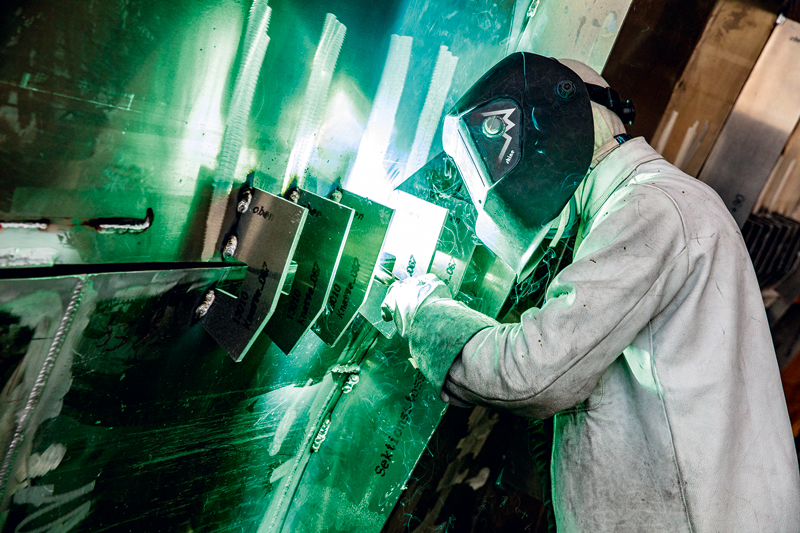
Besides shipbuilding, the Naval Systems portfolio also includes research and development of autonomous maritime surface systems. The division talks about Manned-Unmanned Teaming (MUM-T), which refers to maritime solutions that combine manned systems like frigates and unmanned systems like surface drones. In April, Naval Systems announced the start of production of the Kraken K3 SCOUT series, an unmanned maritime platform that, depending on the configuration, can be used for maritime surveillance, to protect critical infrastructure and as a weapons platform for military operations. This unmanned surface vessel (USV) is produced at Blohm+Voss as part of a joint venture with the British Kraken Technology Group under the company name Rheinmetall Kraken.
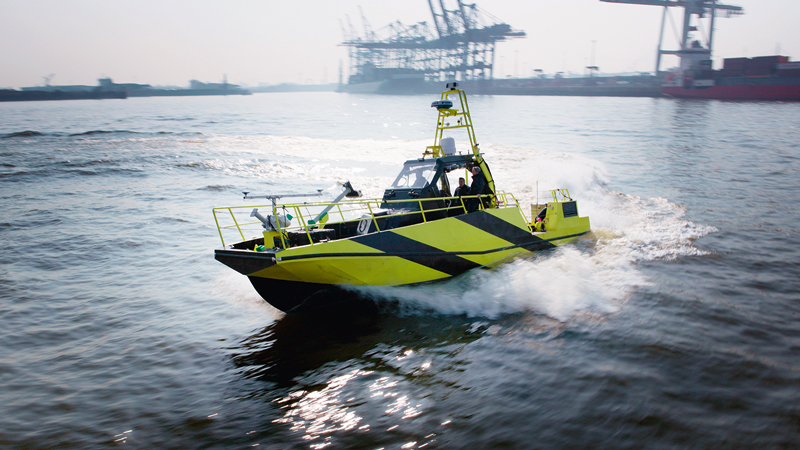
Rheinmetall also introduced the twelve-metre-long AMC12 operational boat in April, an autonomous-capable test bed that, thanks to interchangeable modules, enables flexible integration of various technologies, from navigation and sensor systems to communication solutions and AI applications. Potential functions include protecting pipelines and offshore wind farms, surveillance and defence. Rheinmetall developed the AMC12 in strategic collaboration with IBM, Anschütz and besecke. The range of services in this segment is rounded off with an operator model that goes by the name Intelligence, Surveillance and Reconnaissance as a Service (ISRaaS). With this model, Rheinmetall offers its customers an effective solution for continuous surveillance of predefined areas of the sea with unmanned boats. Collected using state-of-the-art sensors, the data are compiled at a data centre and then provided to the customer for comprehensive situational awareness and anomaly detection. The company is in charge of all procurement, maintenance and operation of unmanned patrol units.
“Development is moving rapidly towards the automation, modularity and scaling of series production,” says Wagner, looking to the future. But the focus will largely shift to USVs and hybrid fleets in the future. “In current conflicts, we’re experiencing a dynamic that is increasingly influenced by autonomous and highly automated systems. In addition, security risks to maritime infrastructure have increased in the North and Baltic Seas. We need to find effective answers to these threats,” explains Wagner. “Autonomous underwater and surface systems have the advantage of offering fast and flexible responses, reduced risk for the crew and high operational efficiency.” (bre)
Facts
Naval Systems
Founded: 1 March 2026 as a division of Rheinmetall AG
Employees: Approx. 2,000
Primary areas of activity: Maritime shipbuilding solutions, research and development of autonomous maritime surface systems
Locations: Bremen, Hamburg, Lemwerder, Wilhelmshaven and Wolgast, plus design offices and branches in Egypt, Brunei, Bulgaria, Croatia and Singapore